
Help for a friend: a practical guide to real support

Helping a friend through emotional struggles means providing consistent, non-judgmental presence, not fixing their problems. This kind of support, which mental health professionals call psychosocial support, is one of the most protective factors in a person’s recovery.
The Jed Foundation and the CDC both confirm that steady, caring connection matters more than perfect advice. Getting this right requires recognizing warning signs early, knowing how to listen well, and understanding when to encourage professional help. This guide gives you the tools to do all three, while also protecting your own mental health along the way.
How do you know when a friend needs help?
Recognising the signs that a friend is struggling is the first step toward offering meaningful support. Behavioural changes are often the clearest signal. Watch for withdrawal from social activities, sudden changes in sleep or eating, increased irritability, or a loss of interest in things they used to enjoy. These patterns do not always mean a crisis, but they do mean your friend may need someone to check in.
Starting the conversation is often the hardest part. Many people worry that asking about mental health will make things awkward, but friends usually feel relief that someone noticed. A simple, direct question like “Are you OK?” or “How can I support you right now?” opens the door without pressure. Avoid leading with assumptions such as “You seem depressed.” Let your friend name their own experience.
The setting matters too. Shared activities like walks, gaming, or eating together reduce anxiety and make it easier to talk. A relaxed environment lowers the stakes and gives your friend permission to open up at their own pace.
Watch for withdrawal from friends, family, or hobbies
Notice changes in sleep, appetite, or energy levels
Pay attention to increased hopelessness, irritability, or tearfulness
Listen for comments that suggest they feel like a burden to others
Take any mention of self-harm or suicide seriously and immediately
Pro Tip: Ask “Do you want me to listen, or do you want help thinking through solutions?” This one question removes a lot of pressure from both of you and shows genuine respect for your friend’s needs.
Practical ways to give ongoing emotional support
Consistency is the foundation of real support. Showing up once is kind. Showing up week after week is what actually helps. You do not need clinical training to be a reliable presence in someone’s life. What you need is patience, a willingness to listen, and a few practical habits.

Active listening is the most underrated skill in supporting a friend. This means reflecting back what you hear (“It sounds like you’re exhausted”), validating their feelings (“That makes complete sense”), and resisting the urge to jump to solutions. Effective support is built on non-judgmental check-ins, not perfect advice. Your friend does not need you to fix anything. They need to feel heard.
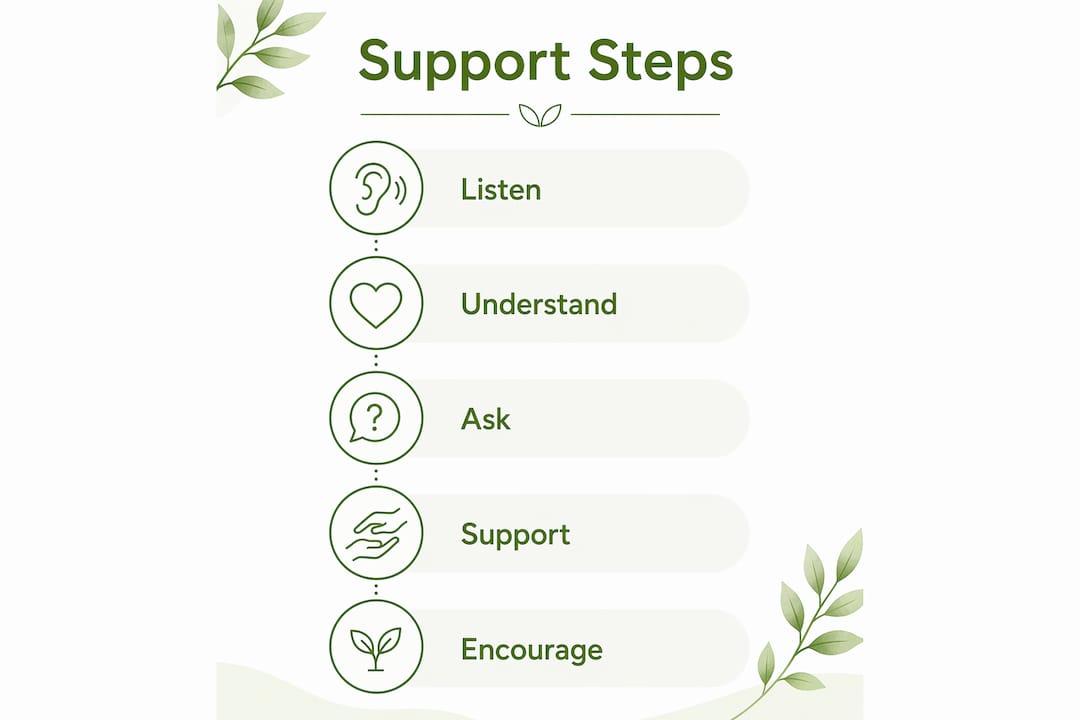
Follow-through is where most people fall short. Most people forget specific details after a few days, which means remembering key moments, like a difficult appointment or a hard conversation, signals genuine care. Texting your friend on the day of a therapy session or a stressful event, without being prompted, tells them you are paying attention.
Here is a practical framework for ongoing support:
Schedule regular check-ins. A weekly text or call does not require much effort, but it creates a reliable rhythm your friend can count on.
Use shared activities. Suggest a walk, a meal, or a low-key outing. Being together without pressure to talk can be just as valuable as a deep conversation.
Validate before advising. Always acknowledge what your friend is feeling before offering any perspective or suggestion.
Share the load. If you have mutual friends, coordinate so that no single person carries all the responsibility.
Avoid unsolicited advice. Unless your friend asks for your opinion, focus on listening rather than problem-solving.
Pro Tip: Keep a simple note on your phone with key dates your friend has mentioned, like a job interview or a difficult anniversary. Reaching out on those days costs you two minutes and means everything to them.
When should you encourage your friend to see a professional?
Some situations call for more than friendship can provide. Knowing when to encourage professional help is one of the most important skills you can develop as a supporter. The signs that professional support is needed include persistent low mood lasting more than two weeks, significant changes in daily functioning, expressions of hopelessness, or any mention of self-harm or suicide.
A three-stage approach works well here: listen fully, gently offer the idea of professional support, and then respect your friend’s autonomy if they decline. Framing therapy as an addition to your friendship, not a replacement for it, removes a lot of the stigma. You might say, “I’m always here for you, and I also think talking to someone trained in this could give you extra support.” That framing positions professional help as a resource, not a rejection.
Asking directly about suicide does not increase risk. Open conversations about suicidal thoughts are an important part of prevention and can guide your friend toward the right support. If your friend is in immediate danger, call 911 or go to emergency without hesitation.
Key resources available to Montrealers and Canadians include:
988 Suicide Crisis Helpline: Call or text 988, available 24 hours a day across Canada
Kids Help Phone: Call 1-800-668-6868 or text CONNECT to 686868
Tel-Aide Outaouais: 613-741-6433, available in both English and French
Info-Social (811): Quebec’s province-wide line for non-emergency mental health guidance
Emergency services: Call 911 for any immediate risk of harm
Situation | Recommended action |
Friend seems withdrawn or sad | Check in with a simple, caring question |
Friend mentions feeling hopeless | Listen, validate, and gently mention professional support |
Friend mentions self-harm or suicide | Ask directly, stay with them, and connect them to a crisis line |
Friend is in immediate danger | Call 911 or go to the nearest emergency room |
If your friend declines therapy, do not push. Avoid pressuring them, as this can damage the relationship and make them less likely to seek help later. Keep the door open by saying, “I’ll always be here when you’re ready.”
How do you protect your own mental health while supporting a friend?
Supporting someone through a mental health challenge takes a real toll. Caregiver burnout is a genuine risk, and it happens gradually. You may notice yourself feeling drained after conversations, losing sleep over your friend’s situation, or neglecting your own needs. These are signs that you need to tend to your own wellbeing.
Setting boundaries is not selfish. It is what makes sustained support possible. You cannot be available at all hours, and you should not try to be. Letting your friend know your limits, kindly and clearly, protects both of you. Sharing caregiving responsibility among mutual friends is one of the most practical ways to prevent any one person from burning out.
If your friend is dealing with addiction, attending a support group like Al-Anon can help you manage guilt and avoid burnout regardless of the choices your friend makes. These groups exist specifically for people in your position. You can also explore addictions therapy in Montreal if you need professional guidance for yourself.
Practical self-care strategies for supporters include:
Set clear limits on availability, such as not responding to messages after a certain hour
Talk to your own support network, whether friends, family, or a counsellor
Recognise that you cannot control your friend’s choices or recovery
Seek your own therapy if you feel consistently overwhelmed or anxious
Practise what one framework calls “radical gentleness,” caring for yourself and your friend equally, and recognising the limits of your influence
Pro Tip: If you notice you are spending more time worrying about your friend than attending to your own life, that is a signal to seek support for yourself. Theraspace offers stress and burnout therapy for people in exactly this position.
Key takeaways
Effective support for a friend in emotional distress requires consistent presence, clear limits, and knowing when to involve professionals.
Point | Details |
Presence over advice | Consistent, non-judgmental check-ins matter more than having the right words. |
Follow through on details | Remembering key dates and appointments signals genuine care and strengthens trust. |
Use a three-stage approach | Listen fully, gently suggest professional help, and respect your friend’s decision if they decline. |
Protect your own wellbeing | Set clear limits and share caregiving responsibility to prevent burnout. |
Know the crisis resources | In Canada, 988 and 911 are the two most important numbers to have ready. |
What I’ve learned from watching people try to help
The most common mistake I see is the one nobody talks about: the slow fade. Someone shows up beautifully in the first week, sends the right messages, says all the right things. Then life gets busy. The check-ins stop. The friend is left wondering if they were too much.
Real support is not a grand gesture. It is a text on a Tuesday. It is remembering that your friend had a hard appointment and asking how it went. That kind of follow-through is rarer than people think, and it matters more than any single conversation.
The other thing I have noticed is how much guilt supporters carry. They feel responsible for their friend’s recovery, and when things do not improve, they blame themselves. That guilt is understandable, but it is also a trap. You are not your friend’s therapist. You are their friend. Those are different roles, and keeping them separate protects both of you.
The concept of “radical gentleness” has stayed with me. It means caring for yourself and your friend with equal seriousness, and accepting that you cannot control outcomes. You can show up. You can listen. You can point toward help. What your friend does with that is their choice, and that is OK.
Patience is the skill nobody mentions in these guides. Recovery is not linear. Your friend may seem better, then worse, then better again. Staying steady through that cycle, without withdrawing or panicking, is the most valuable thing you can offer.
— Virginia


Comments